Accessible Boundaries 🚧
These resources are designed to help people with disabilities reduce the emotional labour of self-advocacy. This page explains what accessible boundaries look like, why inaccessible ones cause harm, and how to show up as a genuine ally to the neurodivergent community.
If Someone Sent You This Page
They are probably trying to tell you something that has been hard to say out loud. This is not an accusation. It is an invitation to understand their experience well enough to show up for them.
The most useful thing you can do right now is read it without preparing your response.
Before You Continue
This page uses specific definitions drawn from disability scholarship and community rights advocacy, not always the intuitive ones. If any are new to you, a quick look is worth it before continuing.
- Ableism — Why disability changes the stakes of how boundaries are set and communicated
- Strategic Ignorance — What happens when someone consistently opts out of information that would make them accountable
- The Double Empathy Problem — Why communication gaps across neurotypes are mutual, not one-sided
- Reasonable Accommodations — Why a person’s access needs have real consequences that others don’t get to decide the weight of
- Spoon Theory — Why the cost of inaccessible boundaries is not abstract, especially for people with co-occurring or chronic conditions
What Are Accessible Boundaries?
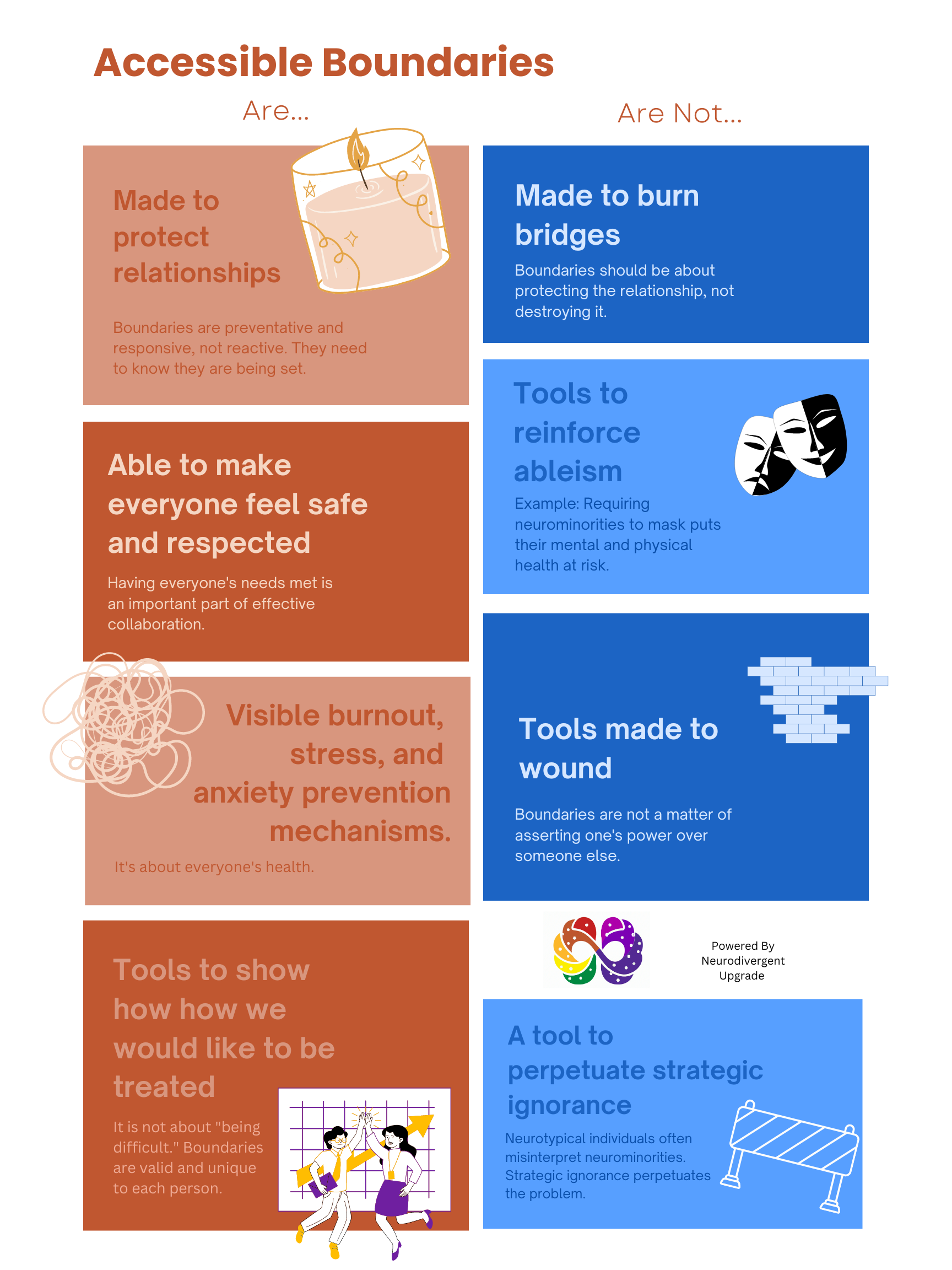
Accessible boundaries are boundaries that everyone involved can actually understand and act on, grounded in active listening.
They protect relationships and prevent burnout. They tell someone how you would like to be treated in terms specific enough to follow through on.
They are not tools to wound, burn bridges, assert power, or perpetuate strategic ignorance, the pattern that occurs when someone consistently misreads another person’s behaviour and responds with consequences, without ever naming the problem.
Disabilities affect a person’s capacity to adapt and absorb costs. This means boundary-setting can be a matter of physical safety, not just interpersonal preference. The responsibility to engage carefully is shared (Rosenberg and Chopra 2015; Berne 2015; Strassmann-Peña 2023).
Nobody arrives in relationships as a fully finished person. Some people, especially those with certain diagnoses, trauma histories, or learned communication patterns, are still developing the skills to set, hold, or communicate boundaries. Accessible boundaries create conditions where those skills can be practiced safely, not penalized when they are imperfect.
The bar for care in relationships involving disability, chronic illness, or co-occurring conditions is higher, not lower.
Fear Is Not Neutral
Before we can talk about how accessible boundaries work, we need to talk about what gets in the way of them.
Most failures in this space are not failures of intention. They are failures of familiarity, compounded, in many cases, by fear that was never given the tools to decode itself.
Fear shapes the boundaries we draw and how we draw them. It shapes who we extend patience to. It shapes who we decide is worth decoding, and who we decide is simply too much. And critically, fear is not evenly distributed. Some people carry it as a background hum. Others carry it as an inheritance, epigenetically encoded as a set of instructions written into how their families learned to move through a world that did not make space for them.
Understanding this is not a precondition for setting limits in a relationship. It is a precondition for setting them fairly, in a way that accounts for the full weight of what the other person is navigating.
See the companion page Decoding Unexamined Fear for a fuller treatment of this framework, including what it means to choose to decode rather than retreat, and what that choice costs, and produces, over time.
Accessibility Goes Both Ways
Accessible boundaries are not only a disability issue. Neurotypical people also have a communication gap to bridge, and bridging it is their responsibility too.
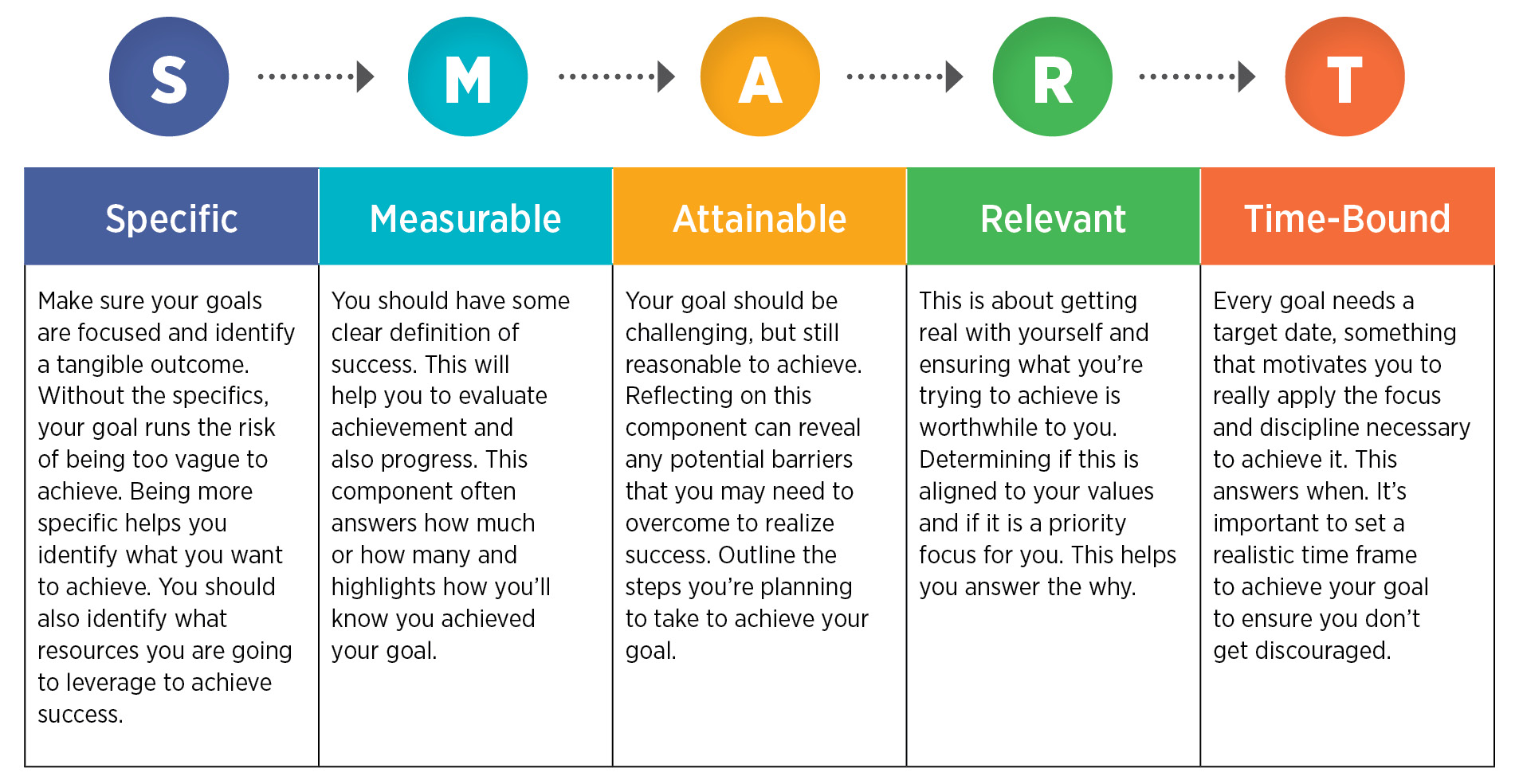
Like any well-formed goal, a boundary works better when it has structure. Before anything else, it helps to check whether a boundary has similar properties to a SMART goal, otherwise, it may be difficult to tell whether it’s working:
A neurominority explaining their experience is not the same as arguing. Explanation is an act of trust. It is someone handing you a map of their internal world and asking you to use it. Responding to that as though it is a debate to be won, or a complaint to be managed, will close the door.
If someone is explaining something and it feels like conflict, ask yourself: are they pushing back, or are they just being specific? Specificity is not aggression. It is what accessible communication requires.
This applies when either person is still developing their boundary skills. Difficulty setting or maintaining limits can show up as over-accommodating, delayed reactions, sudden intensity, or unclear asks. These are not signals to disengage. They are signals that more clarity, more time, and more explicit communication structures are needed. Most people who struggle with setting boundaries just need more support from trusting allies to communicate and maintain them. Asking others for help in keeping boundaries in place is a legitimate and often game-changing form of support-swapping, even when both people are learning at the same time.
The need behind the boundary is what matters, not just the form it takes.
If a goal is too large to act on, you break it into parts, or find a different route to the same destination. Struggling with boundaries is not the same as having bad intentions. It means the process needs more patience and reworking, not disengagement. No two people, neurotypical or neurodivergent, are alike.
✅ Green Flags: Safe and Nonviolent Conflict
These are not a checklist you complete on your own. They are signs that both people were genuinely part of the process.
Everyone can rephrase each other
Before any boundary is drawn or decision is made, both people can restate what the other said in a way that makes them feel accurately represented (Voss and Raz 2016).
This is especially important when one or both people are still developing their boundary skills. Rephrasing reduces the risk of reacting to assumptions, delayed realizations, or misidentified needs.
Sounds like:
- “That’s right.”
- “Yeah…”
- “You get it.”
Most conflicts are resolved through communication improvements alone. If this step is skipped, at least one person is responding while misinformed, and the boundary may not be necessary once that changes.
What to cover: intentions, assumptions, needs, and specific asks from both sides.
The other person’s reality shaped the outcome
You asked, and genuinely listened to, what the boundary would mean for them: health, finances, logistics, their ability to provide for or care for themselves. You listened to their explanation, then asked whether they were okay with that. Their answer informed what happened next.
When someone is still developing boundary skills, they may not immediately know what something will cost them. Give space for delayed answers. “I need to think about that” is a sign of skillful self-awareness, not avoidance.
Sometimes people say no for reasons that shift over time. Something difficult before may be manageable later. Allow them to consent to what they take on, and give them credit for what they are willing to contribute.
If significant consequences came up, alternatives were explored together before any decision was made.
Consequences are not always related to mental health. They can be logistical, financial, or physical. The person living with a disability is the authority on what affects them.
No permanent decisions were made under duress
Durable boundaries are not made at the peak of a conflict.
| Avoidant | Confrontational | |
|---|---|---|
| Wrong timing | Too late: options feel drastic | Too soon: missing the full picture |
| Skillful | Start the conversation earlier | Wait for the other person’s full response first |
Timing is a skill, and it can be learned in both directions.
🚩 Signs a Boundary Is Inaccessible
A boundary becomes inaccessible when:
- The other person cannot understand what is being asked in concrete terms
- Consequences were imposed before they had a genuine chance to respond or course-correct
- The standard applied conflicts with how a disability affects their communication or behaviour
- They were never asked what the boundary would cost them
- There is no room for someone to revise, clarify, or arrive at their boundary in stages, which matters for anyone from someone with alexithymia to someone working on conflict avoidance
The pattern that makes boundaries inaccessible in personal relationships, misreading communication differences as defiance, distress as danger, need as manipulation, is the same pattern that operates at a systemic scale. It is a documented form of ableism.
Inaccessible boundaries can have the form of self-protection while functioning as control. The person most affected is best positioned to name the difference.
Meaning Well and Causing Harm
Most people who set inaccessible boundaries were not trying to cause harm. They were working with incomplete information, unfamiliar communication styles, inadequate tools, or unexamined assumptions about what “reasonable” looks like.
Meaning well is not enough on its own, but it matters, because a person who means well is teachable. And that goes in both directions.
If someone in your life is trying, showing up, and getting it wrong in ways that are consistent with not knowing rather than not caring, that is a person worth investing in. You can learn them too: what lands for them, what shuts them down, what they need to feel safe enough to hear you. That is not a compromise of your needs.
It is how the gap gets closed.
Support swapping is what this looks like in practice: you give them language for what you need, they give you insight into how they receive it. Neither person carries the full load of translation alone. Over time, the cost of the conversation goes down, for both of you.
💡 Tips and Tricks
Finding what works does not have to come at the cost of your energy. You do not have to rush it.
If the conversation keeps hitting the same wall: pause it entirely for a few weeks or months before returning, and make sure the other person knows it is happening and why. Without that context, they are likely to come back more stressed and less ready to hear you. Distance is data collection, not avoidance.
If the iteration itself is exhausting: space interactions out with lower-stakes time together, parallel activities, a shared interest, something that does not require either person to perform or process. Rebuilding a baseline of ease makes the harder conversations easier to have and easier to hear.
If either person struggles with boundaries generally: add more structure, not less. Explicit check-ins, agreed-upon pauses, and written follow-ups after difficult conversations are not signs the relationship is broken. They are scaffolding while the skills develop.
If you feel pressure to resolve it quickly: that pressure is usually not coming from the situation itself. Rushed resolutions tend to be fragile ones. A boundary arrived at collaboratively is more likely to hold.
If it is not working and you are not sure why: go back to the rephrasing exercise. If either person still cannot restate the other’s position in a way that makes them feel represented, the conversation has not started yet, regardless of how many times you have had it.
This Feels Harder Than It Should Be
It is hard because these skills were not part of how most people were socialized. Cross-neurotype communication is genuinely different, and most neurotypical people have not had structured practice with it.
Instead of burning through neurodivergent relationships while you develop those skills, lean on the sustainability suggestions above and extend yourself some patience. These skills compound, everything you learn here transfers back into neurotypical environments too.
Research shows that managers who learn to support neurodivergent employees improve measurably across the board. The skills you build in cross-neurotype relationships include:
- Active listening
- Asking better questions
- Managing your own energy
- Root cause analysis over surface-level reactions
- Communicating with precision
- Cognitive flexibility, which is associated with long-term mental wellness
This is especially true when the person you are working with has extended patience to you.
Signs Your Neurodivergent Person Is Doing the Work
Neurominorities are often practiced at giving others access to their internal experience, because waiting to be asked has historically not worked.
Look for whether they are:
- Flagging hard situations in advance rather than waiting for them to land on you
- Naming their own patterns and offering context without being asked
- Asking for specific, concrete things rather than vague reassurance
- Reframing situations to help you understand, not to prevent you from having your needs met
- Continuing to show up in a process that is not working yet
If someone is doing these things, they are not the problem. They are doing quiet, costly work that is rarely visible or acknowledged.
The goal is not to be an inclusive person. It is to become one.
🤝 You Are on the Same Side
The goal is to work with the other person against the problem, not against each other.
- Name the problem, not the person. “This pattern is causing harm” is something you can both work on. “You are the problem” ends the collaboration.
- Repair matters more than being right. A relationship where both people feel safe enough to flag when something is not working is more valuable than winning any single conflict.
- Celebrate what is working. When the rephrasing exercise lands, when a consequence gets named and an alternative gets found, notice it. That is evidence the process works, and that you can do it again.
Engaging in this kind of conversation is genuinely hard work, especially when it is new. The fact that you are here is already something.
Is This Relationship Worth It?
Not every relationship can or should be repaired. Restorative frameworks like this one are never an obligation to stay.
Before deciding, it helps to separate discomfort from evidence of harm.
Discomfort is a normal part of navigating difference, especially when cross-neurotype communication is new. It is worth sitting with before acting on. It sounds like:
- “This is going to be a really hard conversation.”
- “Their emotional expression is a lot for me to take in.” 1
- “It feels complicated.”
- “I was being polite.”
- “I am not sure where to start.”
- “Why can’t they just take a hint?”
- “I worry about saying the wrong thing.”
These are real experiences. They are also workable ones. Discomfort with unfamiliarity is not the same as evidence that something is wrong with the other person or the relationship.
Evidence of harm is a pattern of behaviour with consequences you can name, that persists after you have communicated clearly. It sounds like:
- “They understand what I need and why, because I told them directly and recently, and they cannot or will not follow through.”
- “The last time I tried to leave, they contacted my employer.”
- “They have threatened to share things I told them in confidence.”
The distinction matters because discomfort often resolves with time, tools, and lower-stakes practice. Evidence of harm does not resolve on its own, and it calls for a different response.
Solvable Incompatibility
A solvable problem looks like miscommunication, unmet needs, or missing information between two people acting in good faith. Intensity, persistence, and emotional expression are frequently misread as dysfunction. They are not the same thing.
Cross-neurotype relationships involve a real skill gap, not a preference mismatch. Most neurotypicals were not raised to think of cross-neurotype communication as a basic skill. It is an opportunity to go back, learn new tools, and associate difference with something generative.
Over time, as we learn to live and work together, it compounds into lasting social progress.
If what you are describing sounds more like fact than fear, see the companion page on Unsafe Relationships 🚧 Not available yet TBC.
When It Is Worth It
If it sounds more like fear, take a break, come back to it, and consider:
- Did you interpret an explanation as a boundary or an access need?
- Did you tell them something was okay when it was not?
- Is there a skill they need to learn that you could help with?
- Have you asked them for help when you are struggling to communicate or regulate?
- What was the last version of the relationship that worked? Can you go back to it?
New skills are hard, but they are teachable. Make sure your person is safe too.
References
Footnotes
Problematic because it implies that they are responsible for regulating you.↩︎