ND Upgrade
  • Explainers 🚧
  • Work 🚧
  • University
  • Personal 🚧
  • Key Facts
  • About
  1. Applied Behaviour Analysis (ABA) “Therapy”
  • Explainers

  • Neurodiversity
  • Ableism 🚧
  • Reasonable Accommodations
  • Masking
  • Restorative Justice 🚧
  • Conflict Styles 🚧

  • Accessible Boundaries 🚧
  • Decoding Fear 🚧
  • Cohesive Solidarity
  • Strategic Ignorance

  • The Double Empathy Problem
  • Applied Behaviour Analysis (ABA) “Therapy”
  • Sensory Barriers
  • Spoon Theory
  • Meltdowns

  • Autism
  • ADHD

  • ND Holidays

Neurodivergent Upgrade

On this page

  • What Is It?
  • ABA Mutations

Applied Behaviour Analysis (ABA) “Therapy”

Welcome to the Explainer Section of our website! Here, you’ll find a collection of short and engaging explanations designed to help people with disabilities reduce the emotional labor of self-advocacy.

More explainers on Autism specifically can be found in the Autism explainer section.

What Is It?
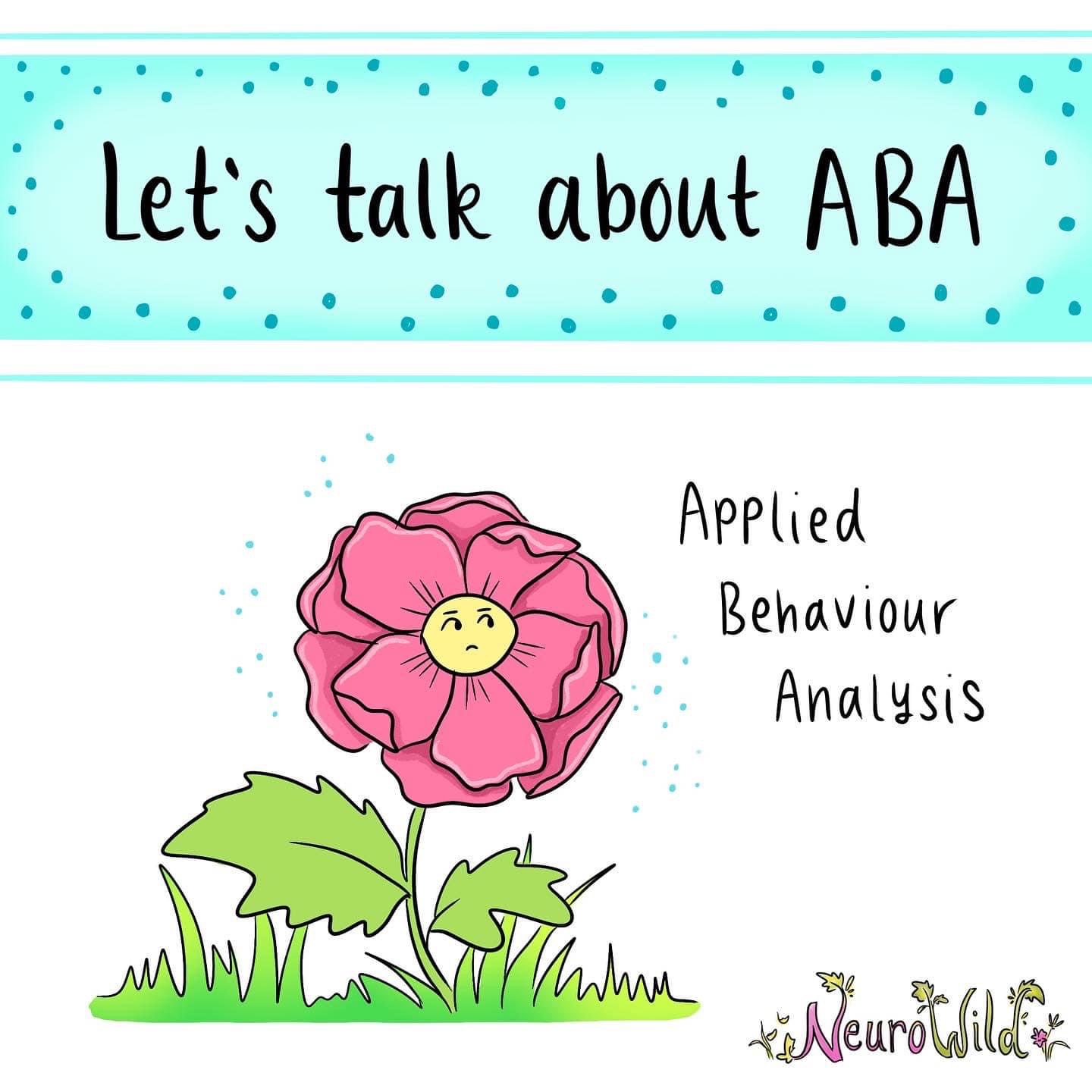
Title slide of a NeuroWild set about ABA. A light blue banner with teal dots reads 'Let's talk about ABA'. Below it is a drawing of a pink flower with a small yellow face that frowns and looks to the side, with green leaves and grass, and teal sparkles around it. Handwritten text beside it reads 'Applied Behaviour Analysis'. The NeuroWild logo is at the bottom right.

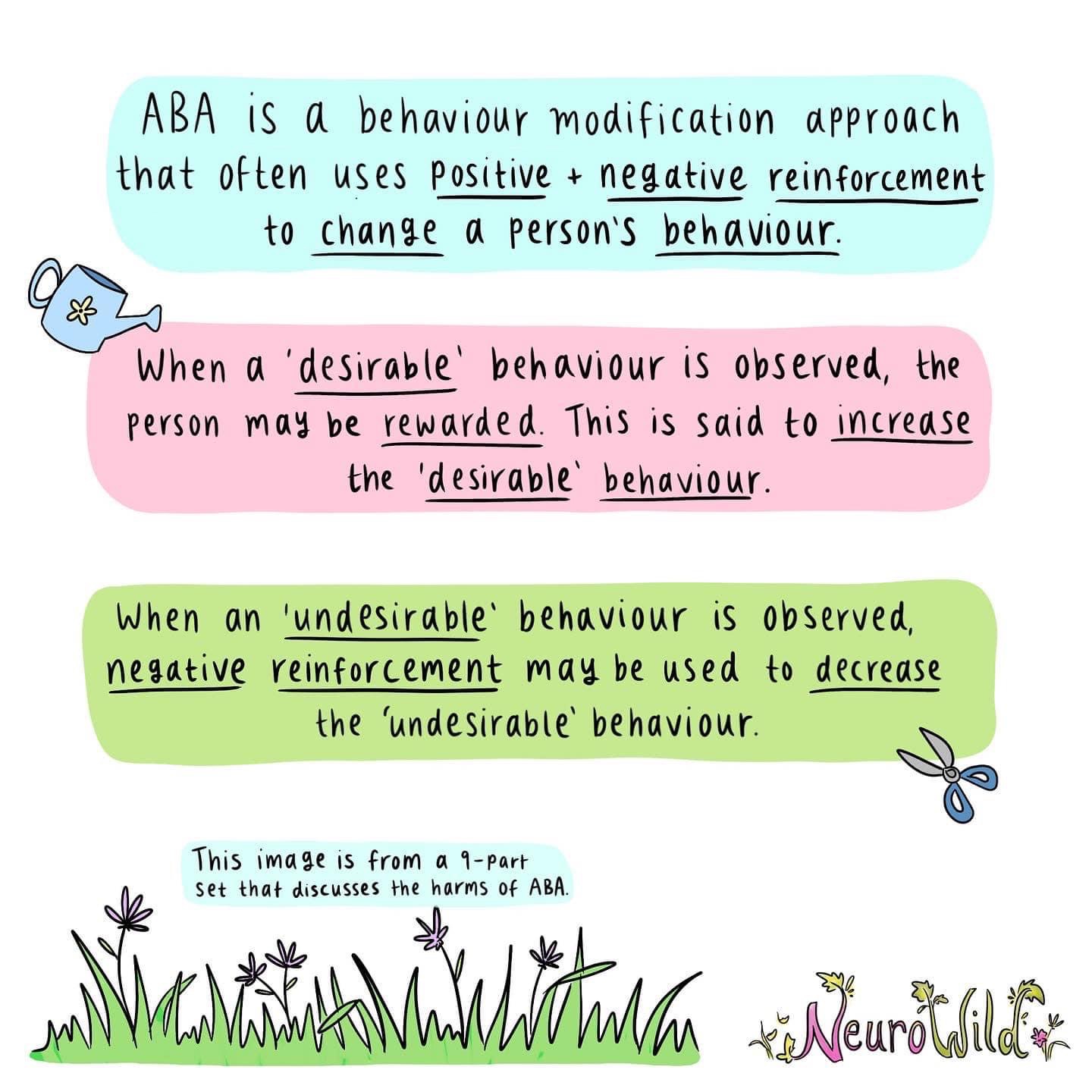
Three colored text blobs with a blue watering can and scissors drawn beside them, and grass and purple flowers along the bottom. Blue blob: 'ABA is a behaviour modification approach that often uses Positive + negative reinforcement to change a person's behaviour.' Pink blob: 'When a 'desirable' behaviour is observed, the person may be rewarded. This is said to increase the 'desirable' behaviour.' Green blob: 'When an 'undesirable' behaviour is observed, negative reinforcement may be used to decrease the 'undesirable' behaviour.' A small note near the grass reads 'This image is from a 9-part set that discusses the harms of ABA.' The NeuroWild logo is at the bottom right.

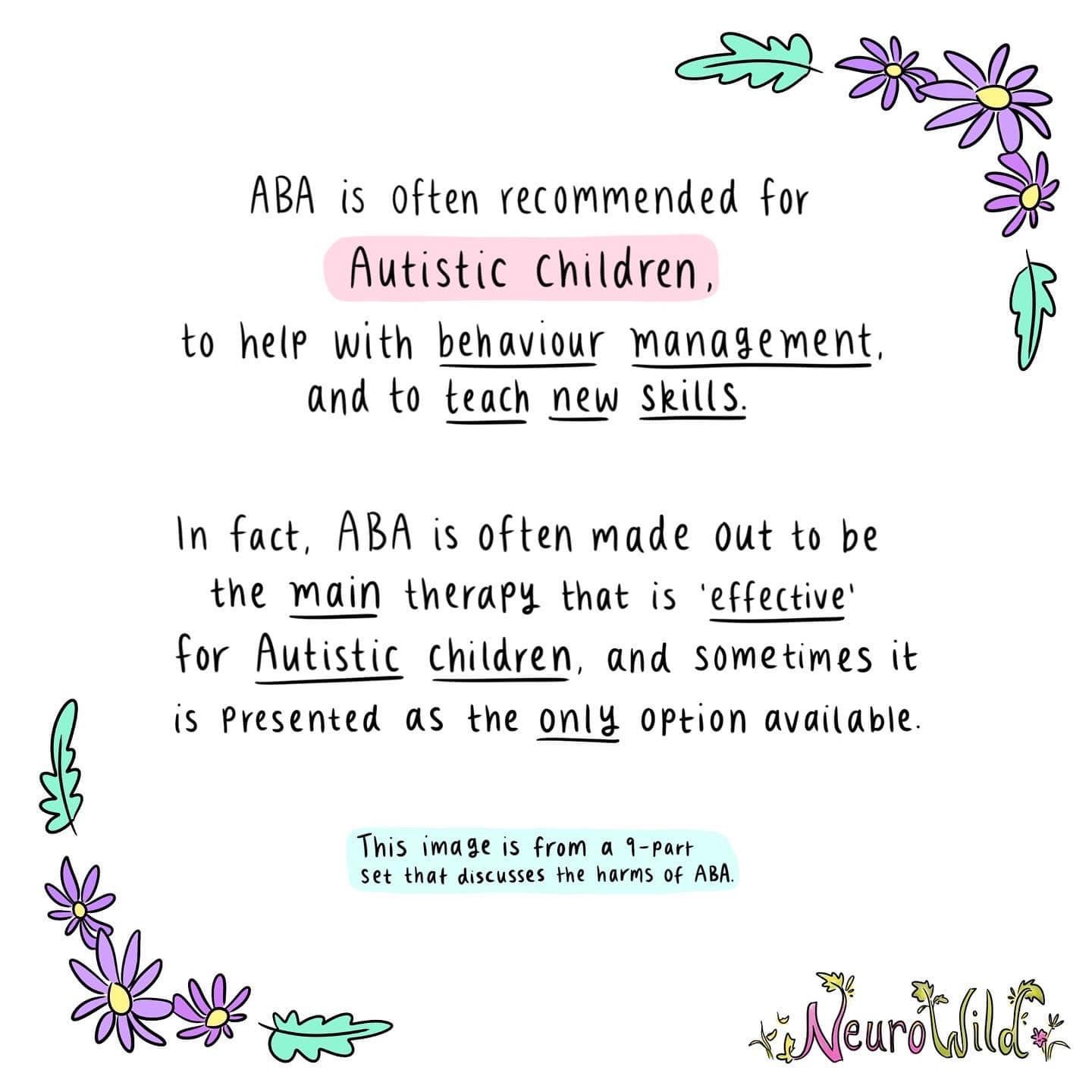
Text slide with a border of purple daisies and teal leaves in the corners. Text: 'ABA is often recommended for Autistic Children, to help with behaviour management, and to teach new skills. In fact, ABA is often made out to be the main therapy that is 'effective' for Autistic children, and sometimes it is presented as the only option available.' Key words are underlined and 'Autistic Children' is highlighted in pink. A small note reads 'This image is from a 9-part set that discusses the harms of ABA.' The NeuroWild logo is at the bottom right.

  • ABA is typically the main recommendation for sourcing support when Autistic adults are first diagnosed. ABA is by far the most common type of “Autism specialist” out there.
  • Therapists with an Autism specialty also tend to be less affordable.
  • When Autistic adults seek therapy elsewhere for depression, or even PTSD, a therapist is allowed and even encouraged to decline care to an Autistic person because they are not an Autism “specialist.”
  • An Autistic person is likely to have comorbidities, like ADHD.
    • Someone with these two diagnoses reaching out to an ADHD specialist, as an example, can be turned down by that ADHD specialist because they are not also specialized in Autism.
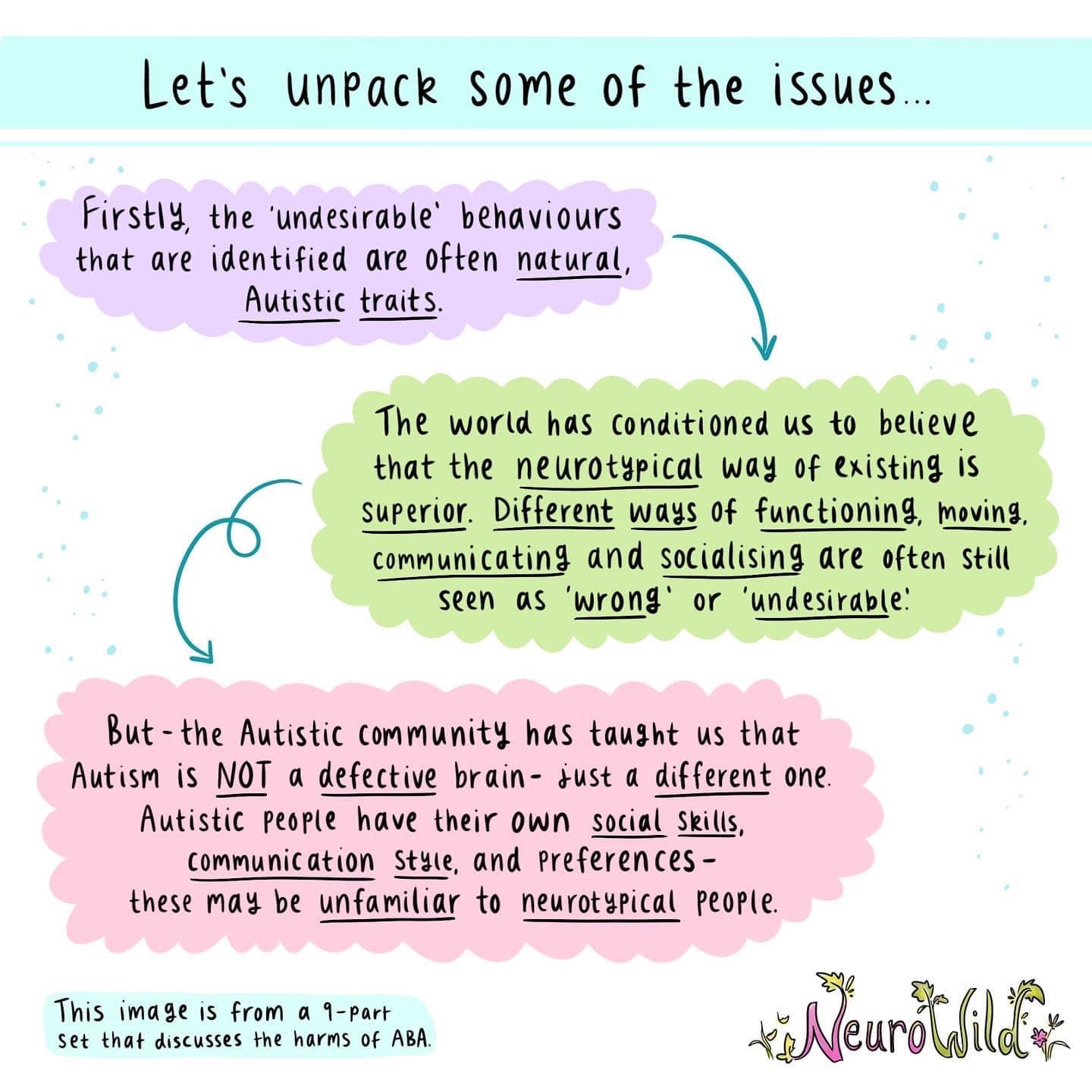
Text slide with a pale blue header reading 'Let's unpack some of the issues...'. Three cloud-shaped blobs joined by teal arrows. Purple: 'Firstly, the 'undesirable' behaviours that are identified are often natural, Autistic traits.' Green: 'The world has conditioned us to believe that the neurotypical way of existing is superior. Different ways of functioning, moving, communicating and socialising are often still seen as 'wrong' or 'undesirable'.' Pink: 'But - the Autistic community has taught us that Autism is NOT a defective brain - just a different one. Autistic people have their own social skills, communication style, and preferences - these may be unfamiliar to neurotypical people.' A note reads 'This image is from a 9-part set that discusses the harms of ABA.' The NeuroWild logo is at the bottom right.

< More On Masking In Our Masking Explainer Page <

Most therapy strategies are a product of the researchers’ demographics, which means therapists with clients from marginalized groups often have to work with them to adapt primarily White, cis, upper-class contexts to their patient.

  • Unfortunately, the fact that Autism is not treated as a valid minority category worth learning about means that therapists can shut down their client for advocating for themselves in therapy and say “I am not trained to deal with your Autism.”
    • … rather than being curious about how to support and working with the human being in front of them to adapt strategies to a neurominority.
  • Despite having a license in psychology, therapists are not required to have a basic understanding of neurodivergence.
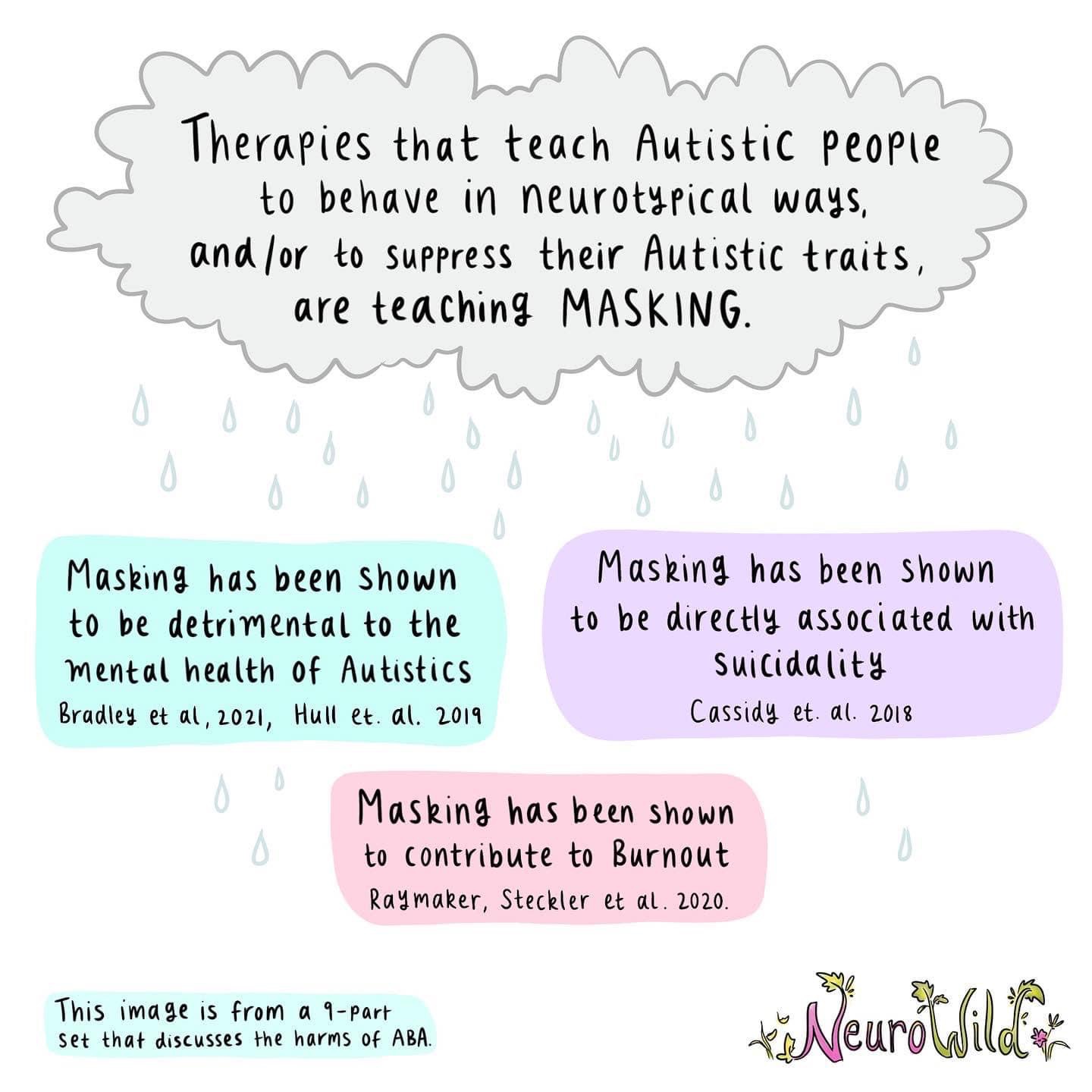
Text slide with a grey rain cloud at the top and light blue raindrops falling. Cloud text: 'Therapies that teach Autistic people to behave in neurotypical ways, and/or to suppress their Autistic traits, are teaching MASKING.' Three colored boxes below. Blue: 'Masking has been shown to be detrimental to the mental health of Autistics. Bradley et al, 2021, Hull et. al. 2019'. Purple: 'Masking has been shown to be directly associated with suicidality. Cassidy et. al. 2018'. Pink: 'Masking has been shown to contribute to Burnout. Raymaker, Steckler et al. 2020.' A note reads 'This image is from a 9-part set that discusses the harms of ABA.' The NeuroWild logo is at the bottom right.

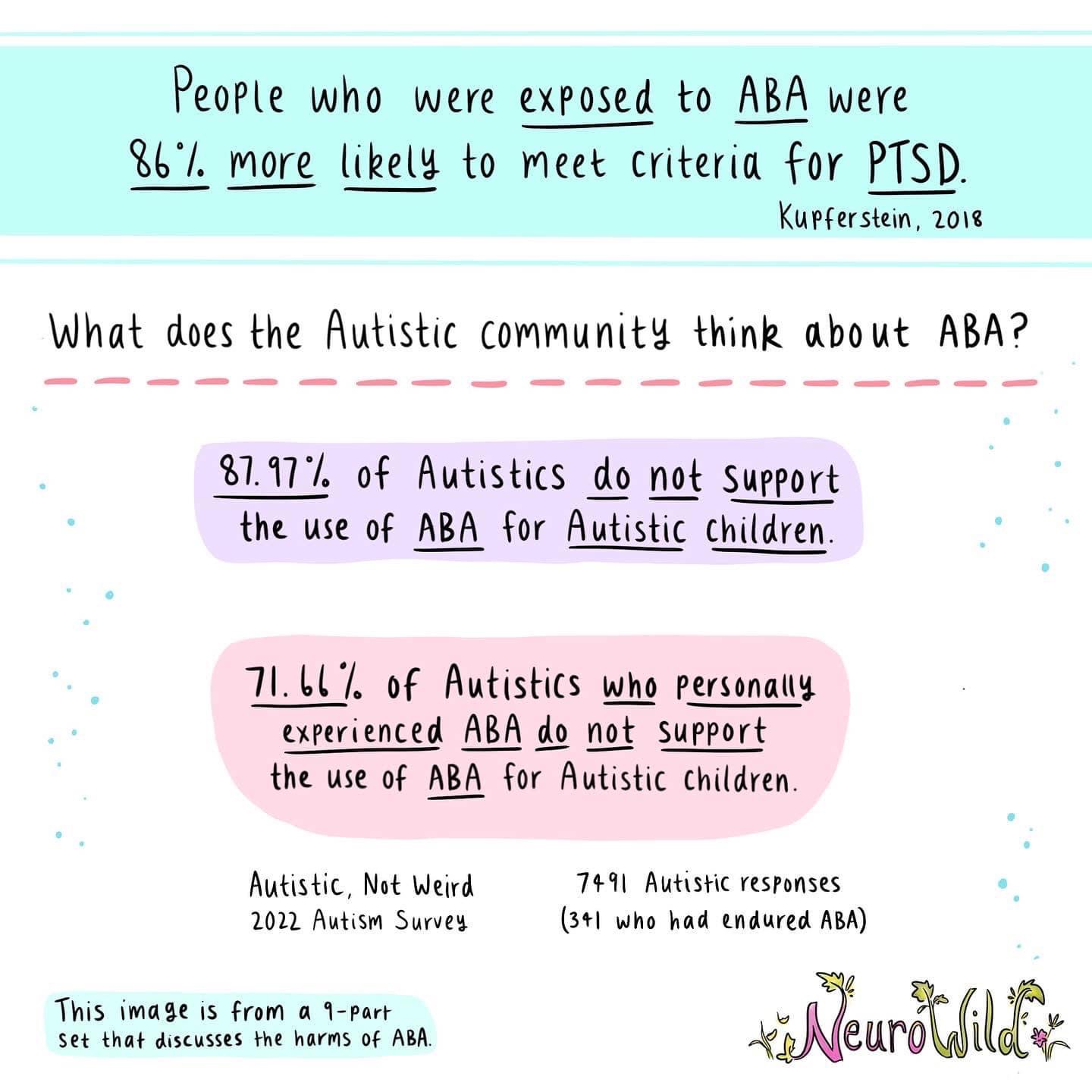
Text slide with a pale blue header band. Header: 'People who were exposed to ABA were 86% more likely to meet criteria for PTSD.' with the citation 'Kupferstein, 2018'. Below: 'What does the Autistic community think about ABA?' above a pink dashed line. Purple blob: '87.97% of Autistics do not support the use of ABA for Autistic children.' Pink blob: '71.66% of Autistics who personally experienced ABA do not support the use of ABA for Autistic children.' Source lines: 'Autistic, Not Weird 2022 Autism Survey' and '7491 Autistic responses (341 who had endured ABA)'. Note near the bottom reads 'This image is from a 9-part set that discusses the harms of ABA.' The NeuroWild logo is at the bottom right.

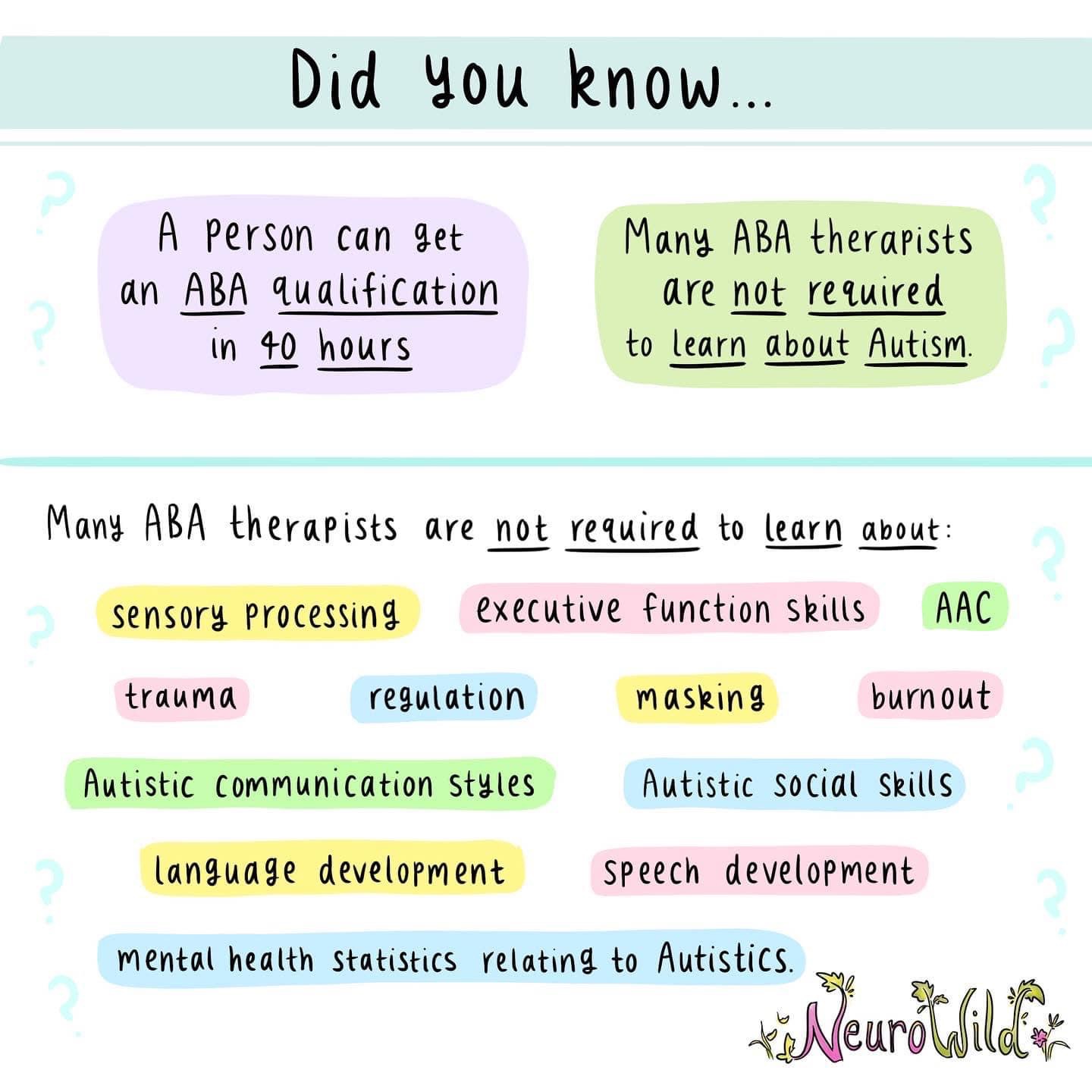
Text slide with a pale green header reading 'Did you know...' and teal question marks along the edges. Purple blob: 'A person can get an ABA qualification in 40 hours'. Green blob: 'Many ABA therapists are not required to learn about Autism.' Below: 'Many ABA therapists are not required to learn about:' followed by small colored tags: sensory processing, executive function skills, AAC, trauma, regulation, masking, burnout, Autistic communication styles, Autistic social skills, language development, speech development, mental health statistics relating to Autistics. The NeuroWild logo is at the bottom right.

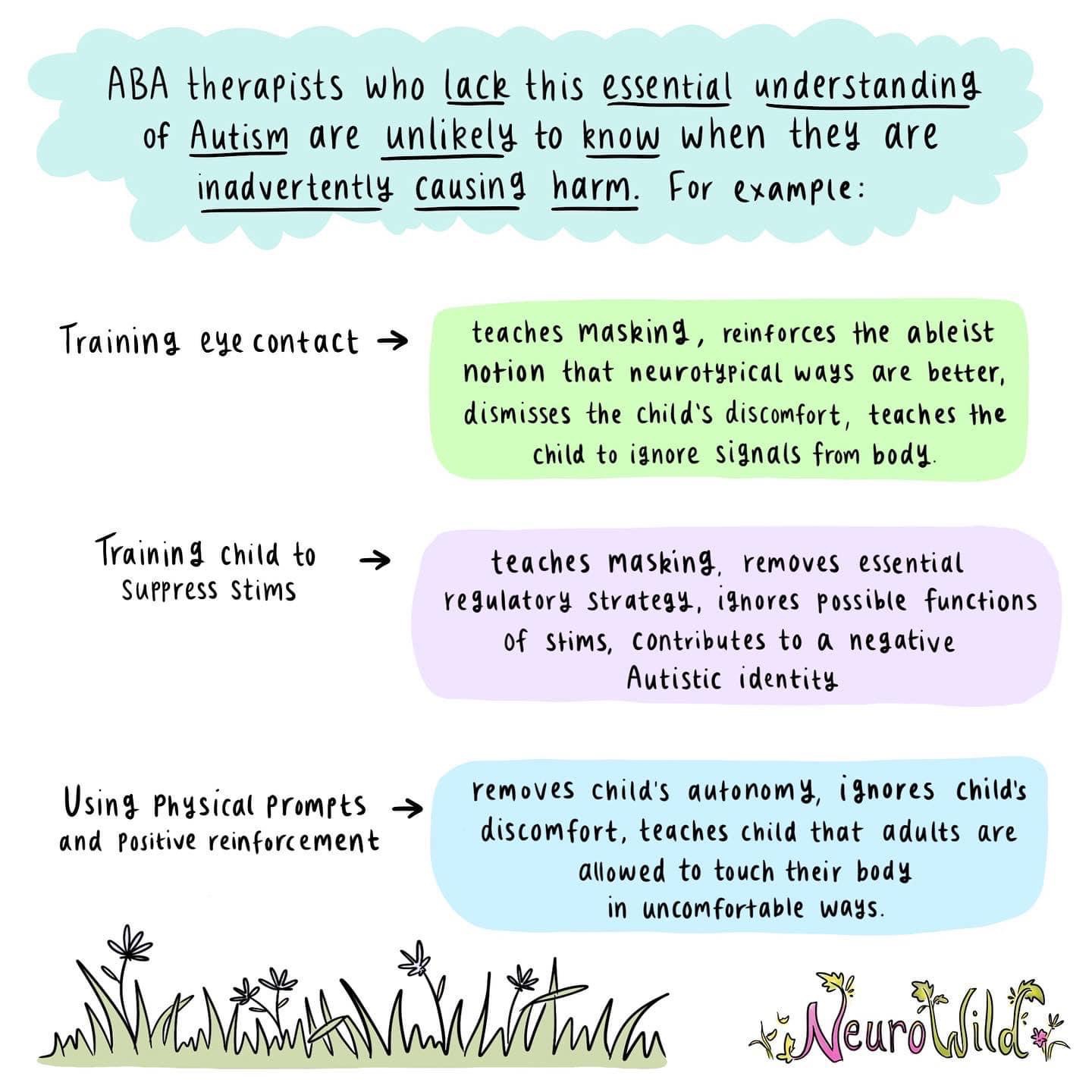
Text slide with grass and flowers along the bottom. Blue cloud at the top: 'ABA therapists who lack this essential understanding of Autism are unlikely to know when they are inadvertently causing harm. For example:' Three rows with arrows. 'Training eye contact' leads to a green box: 'teaches masking, reinforces the ableist notion that neurotypical ways are better, dismisses the child's discomfort, teaches the child to ignore signals from body.' 'Training child to suppress stims' leads to a purple box: 'teaches masking, removes essential regulatory strategy, ignores possible functions of stims, contributes to a negative Autistic identity'. 'Using physical prompts and Positive reinforcement' leads to a blue box: 'removes child's autonomy, ignores child's discomfort, teaches child that adults are allowed to touch their body in uncomfortable ways.' The NeuroWild logo is at the bottom right.

The takeaway is that therapy adapted to support the challenges of Autistic people should not include learning neurotypical social skills.
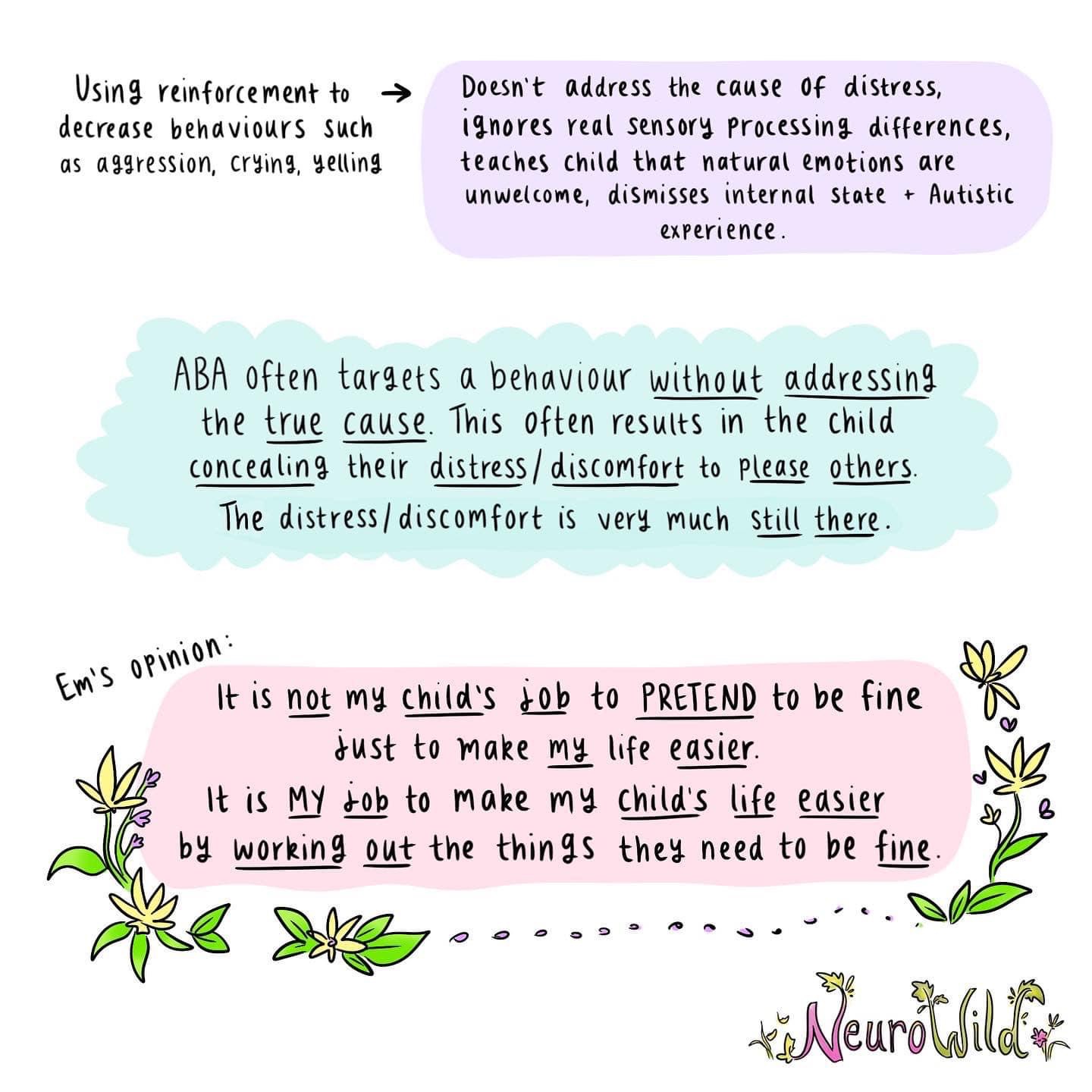
Text slide with flowers and a dotted line of petals. Top: 'Using reinforcement to decrease behaviours such as aggression, crying, yelling' with an arrow to a purple box: 'Doesn't address the cause of distress, ignores real sensory processing differences, teaches child that natural emotions are unwelcome, dismisses internal state + Autistic experience.' Middle blue cloud: 'ABA often targets a behaviour without addressing the true cause. This often results in the child concealing their distress/discomfort to please others. The distress/discomfort is very much still there.' Bottom pink box labeled 'Em's opinion:' reads 'It is not my child's job to PRETEND to be fine just to make my life easier. It is MY job to make my child's life easier by working out the things they need to be fine.' The NeuroWild logo is at the bottom right.

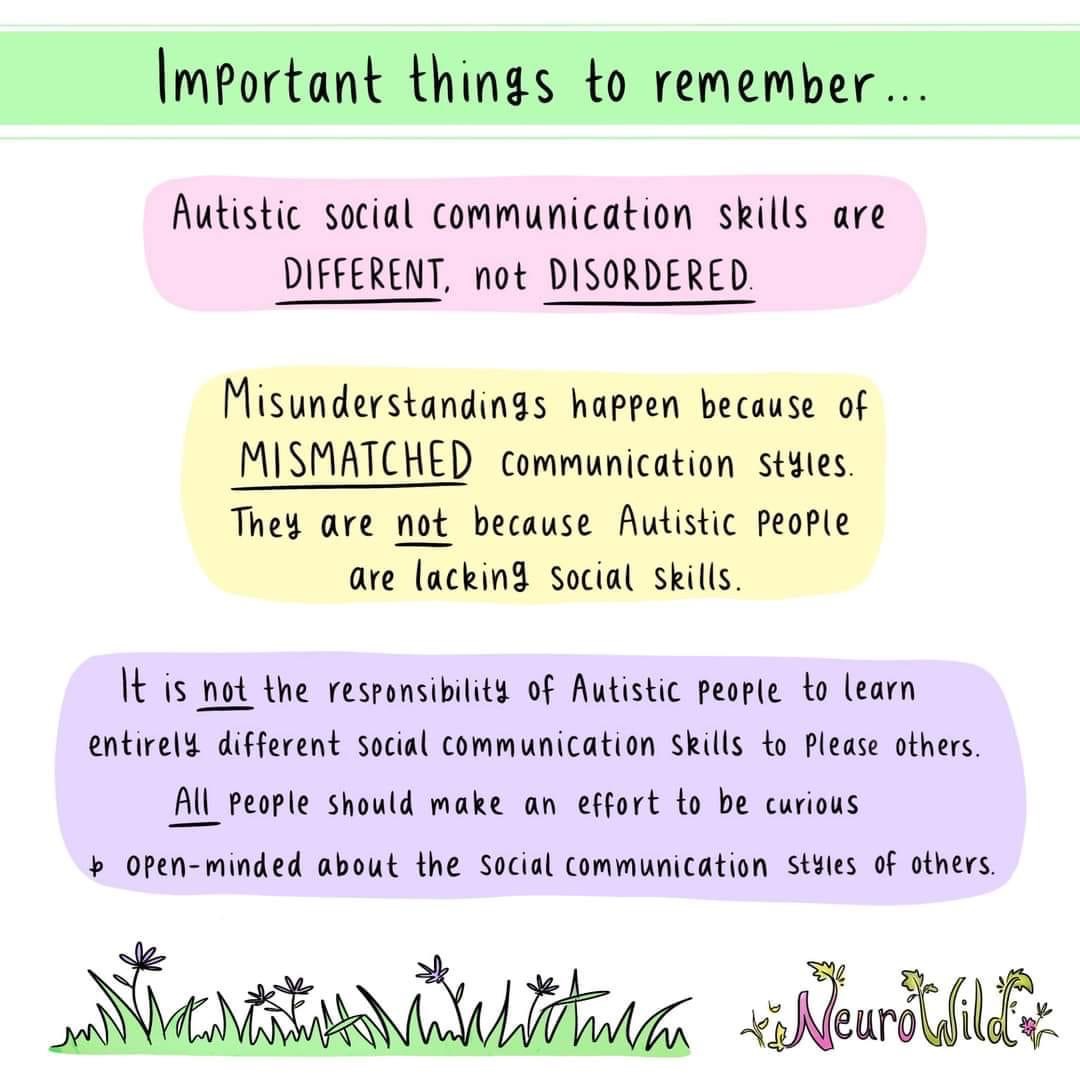
Text slide with a green header reading 'Important things to remember...'. Pink blob: 'Autistic social communication skills are DIFFERENT, not DISORDERED.' Yellow blob: 'Misunderstandings happen because of MISMATCHED communication styles. They are not because Autistic people are lacking social skills.' Purple blob: 'It is not the responsibility of Autistic people to learn entirely different social communication skills to please others. All people should make an effort to be curious + open-minded about the social communication styles of others.' Grass and small purple flowers run along the bottom. The NeuroWild logo is at the bottom right.

ABA Mutations

The field of psychology continues to create “new” versions of ABA.
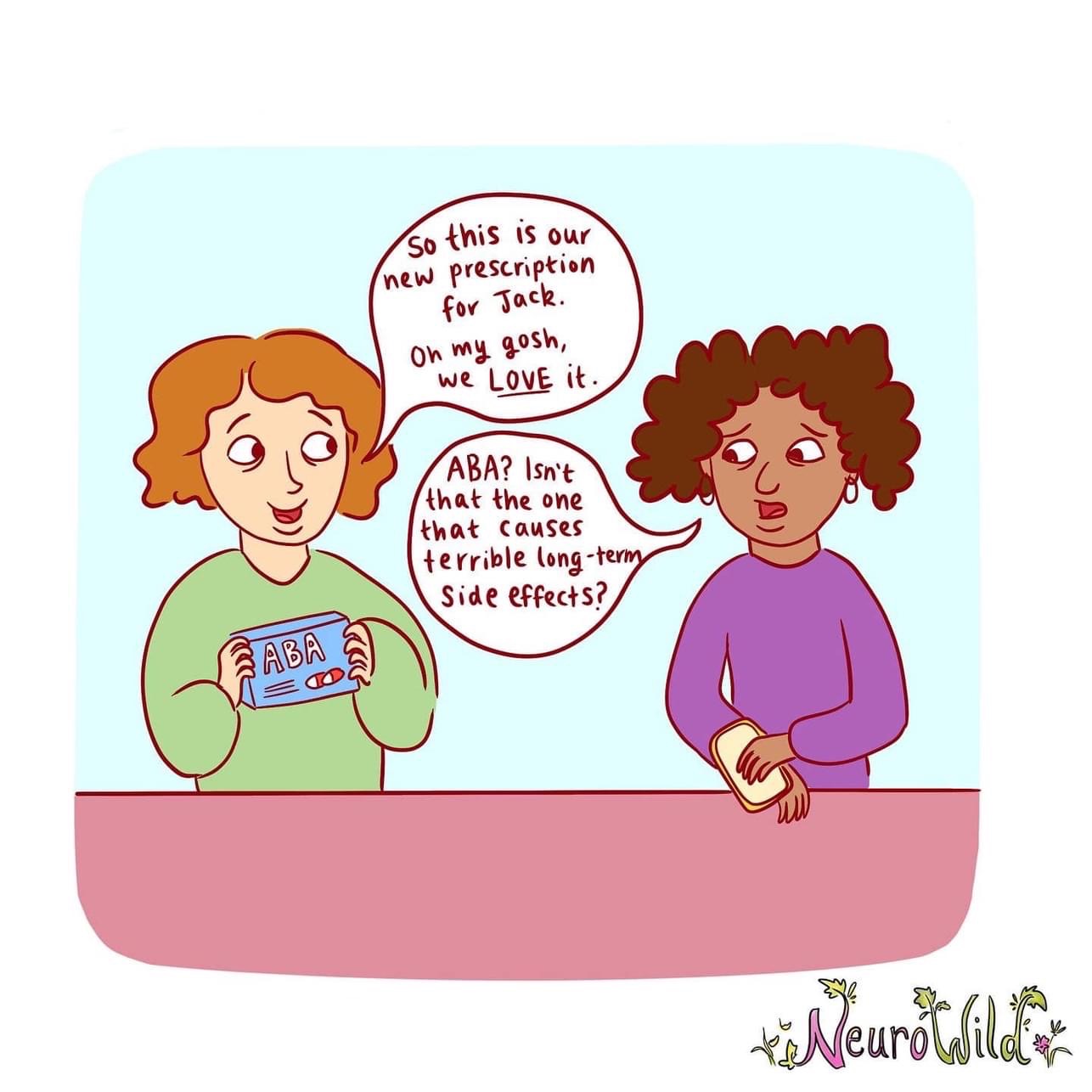
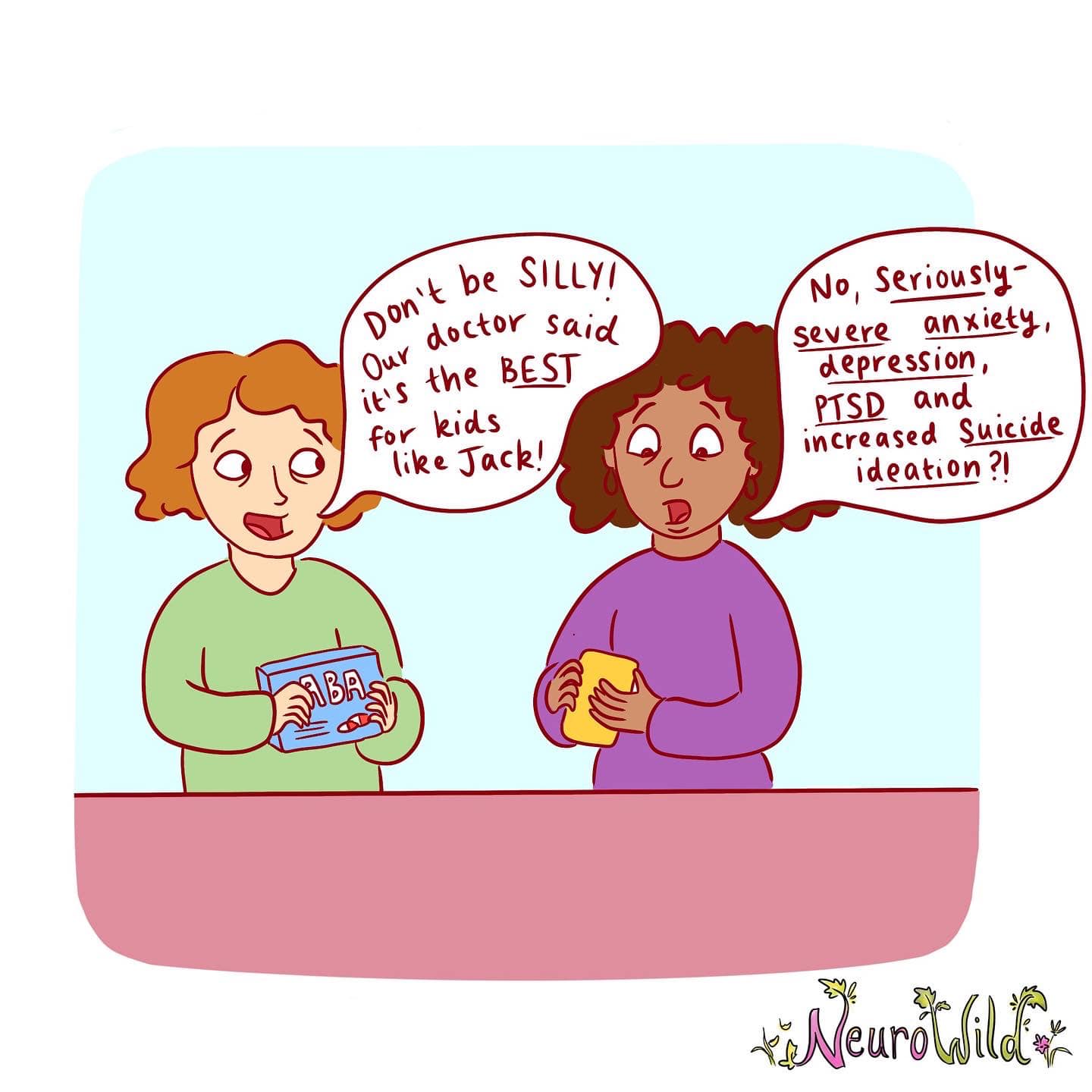
Cartoon comic panel with a light blue rounded square above a pink counter. On the left a person with curly orange hair and a green sweater holds a blue box labeled 'ABA' with a red and white pill drawn on it. Speech bubble: 'So this is our new prescription for Jack. Oh my gosh, we LOVE it.' On the right a person with dark curly hair in a purple sweater holds a yellow sponge-like object and looks worried. Speech bubble: 'ABA? Isn't that the one that causes terrible long-term side effects?' The NeuroWild logo is at the bottom right. Cartoon comic panel with a light blue rounded square above a pink counter. The orange-haired person in the green sweater holds the blue ABA box and says: 'Don't be SILLY! Our doctor said it's the BEST for kids like Jack!' The dark-haired person in the purple sweater holds a yellow object and answers: 'No, Seriously- severe anxiety, depression, PTSD and increased Suicide ideation?!' The NeuroWild logo is at the bottom right.

Unfortunately many of the recent innovations in mainstream support for Autistic folk are simply ABA being repackaged. The fundamental emphasis on having the Autistic person taking responsibility for masking remains ever-present.
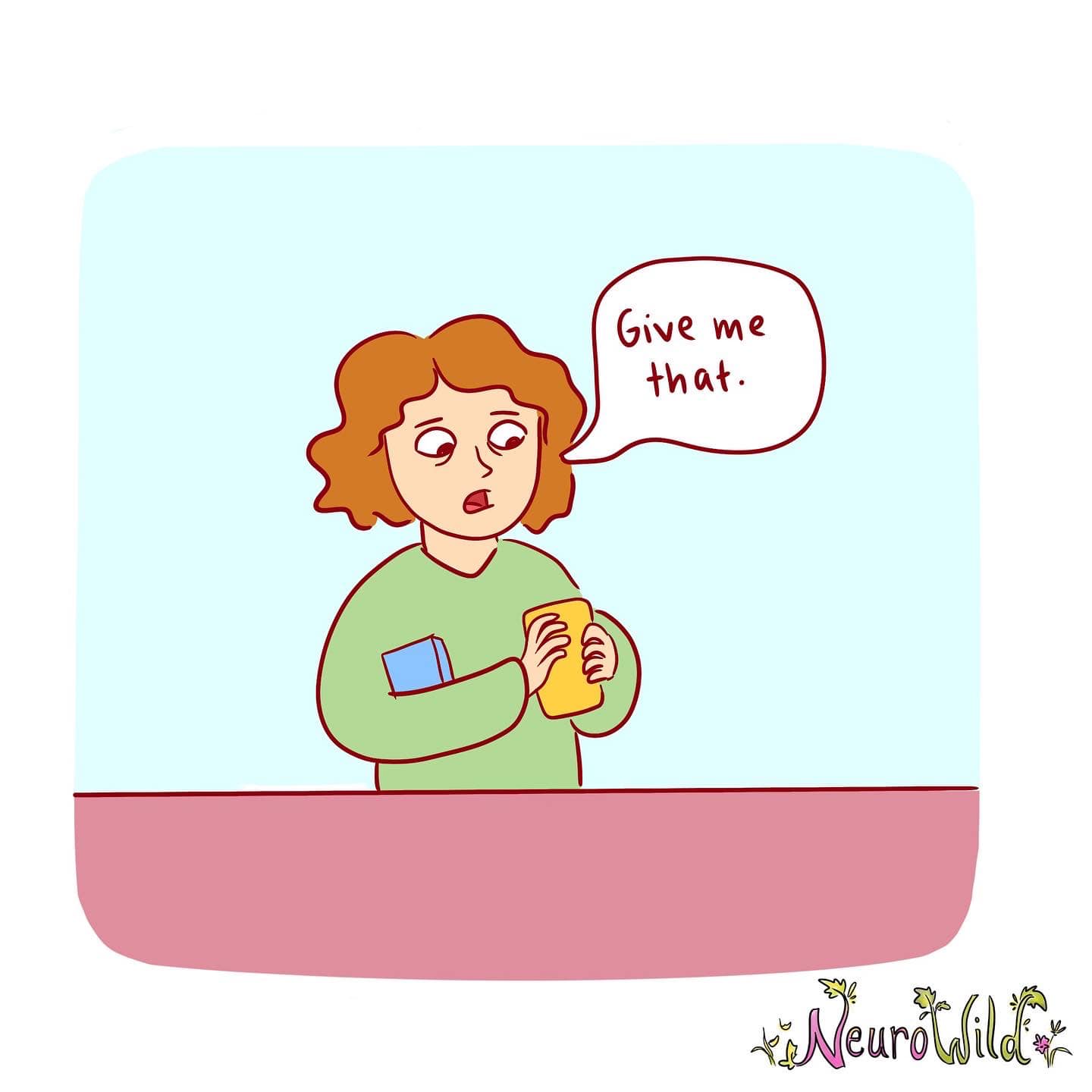
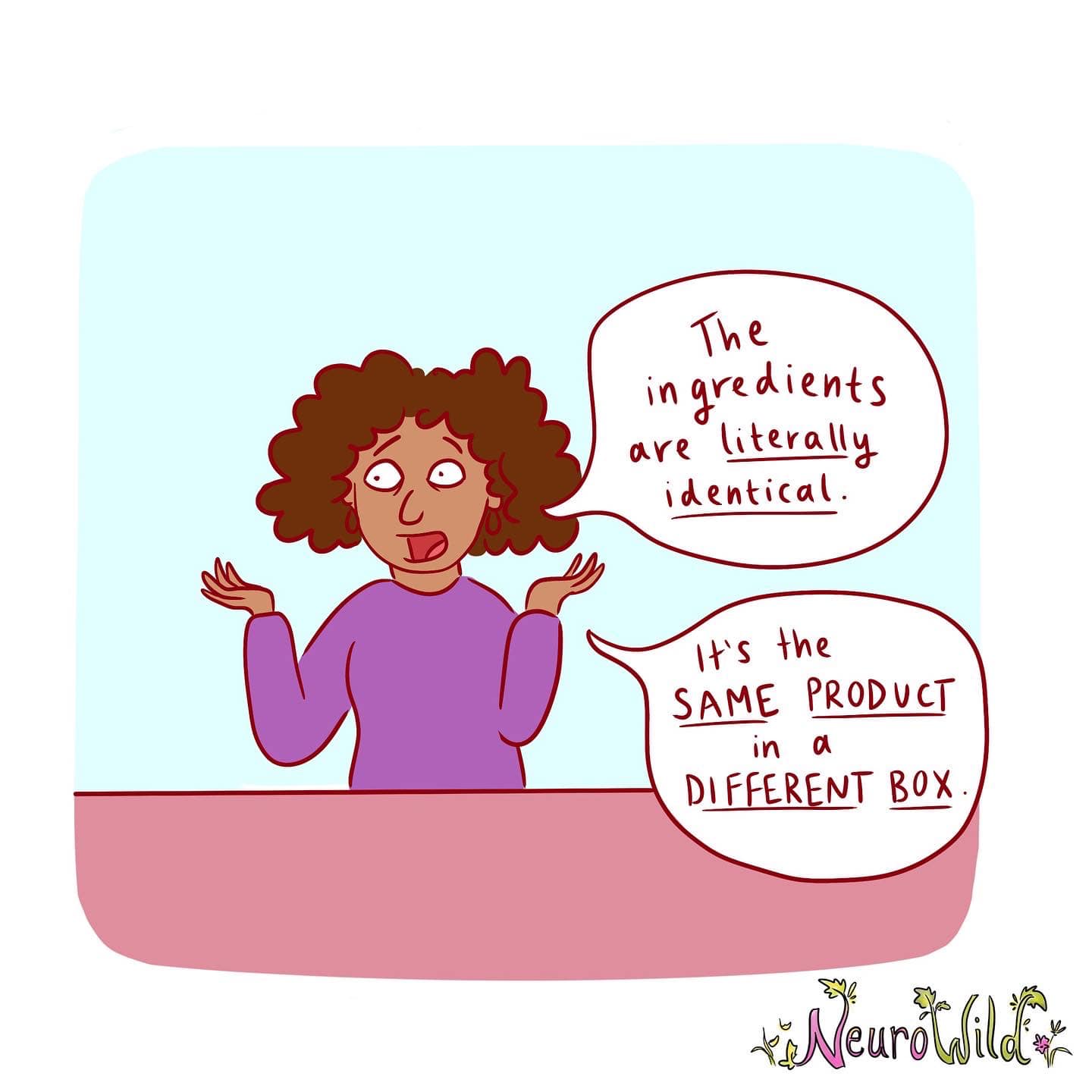
Cartoon comic panel with a light blue rounded square above a pink counter. Close up of the orange-haired person in the green sweater, with a blue box tucked under one arm, taking a yellow object from someone and looking down at it with a concerned expression. Speech bubble: 'Give me that.' The NeuroWild logo is at the bottom right. Cartoon comic panel with a light blue rounded square above a pink counter. The dark-haired person in the purple sweater shrugs with both hands raised and looks distressed. Speech bubbles: 'The ingredients are literally identical.' and 'It's the SAME PRODUCT in a DIFFERENT BOX.' The NeuroWild logo is at the bottom right.

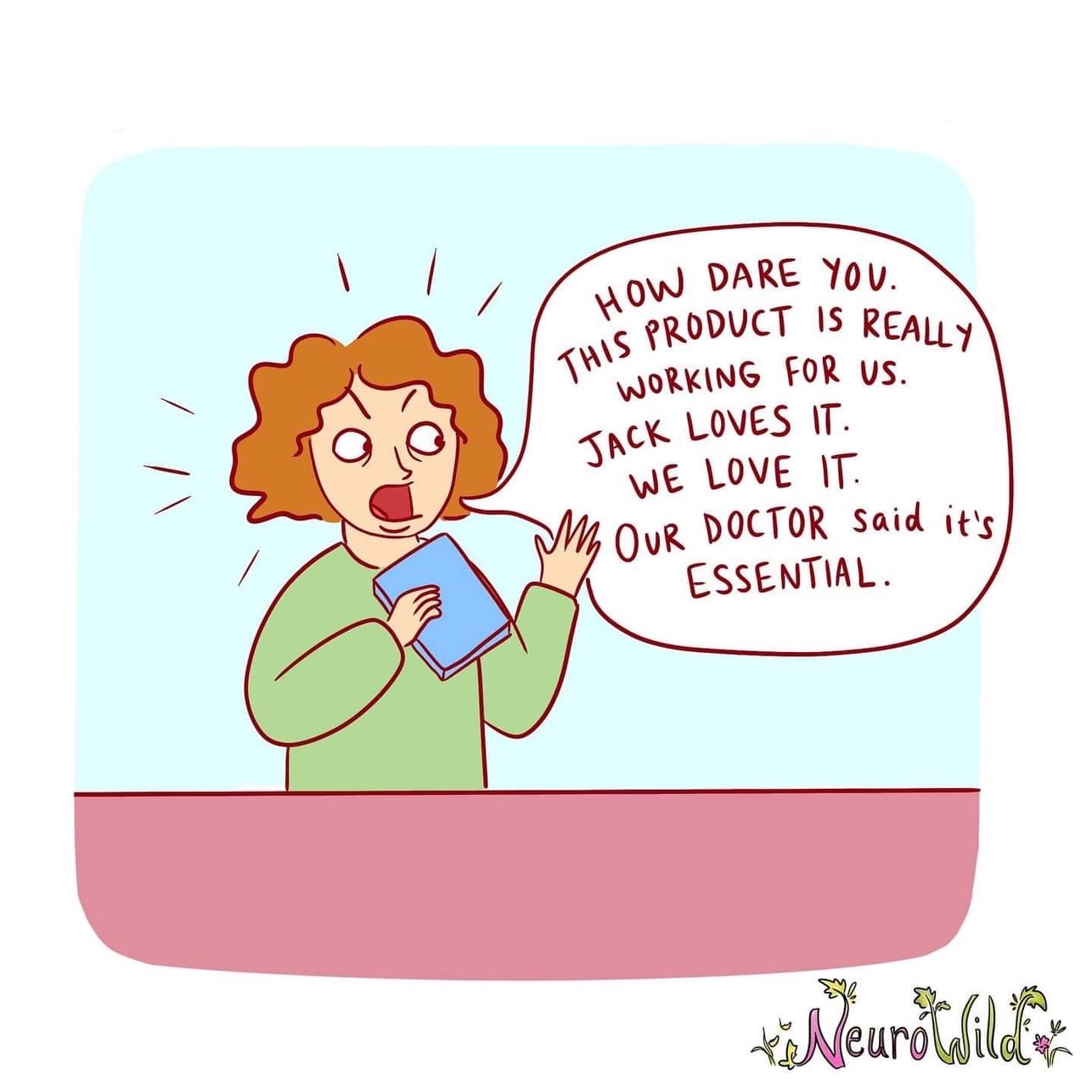
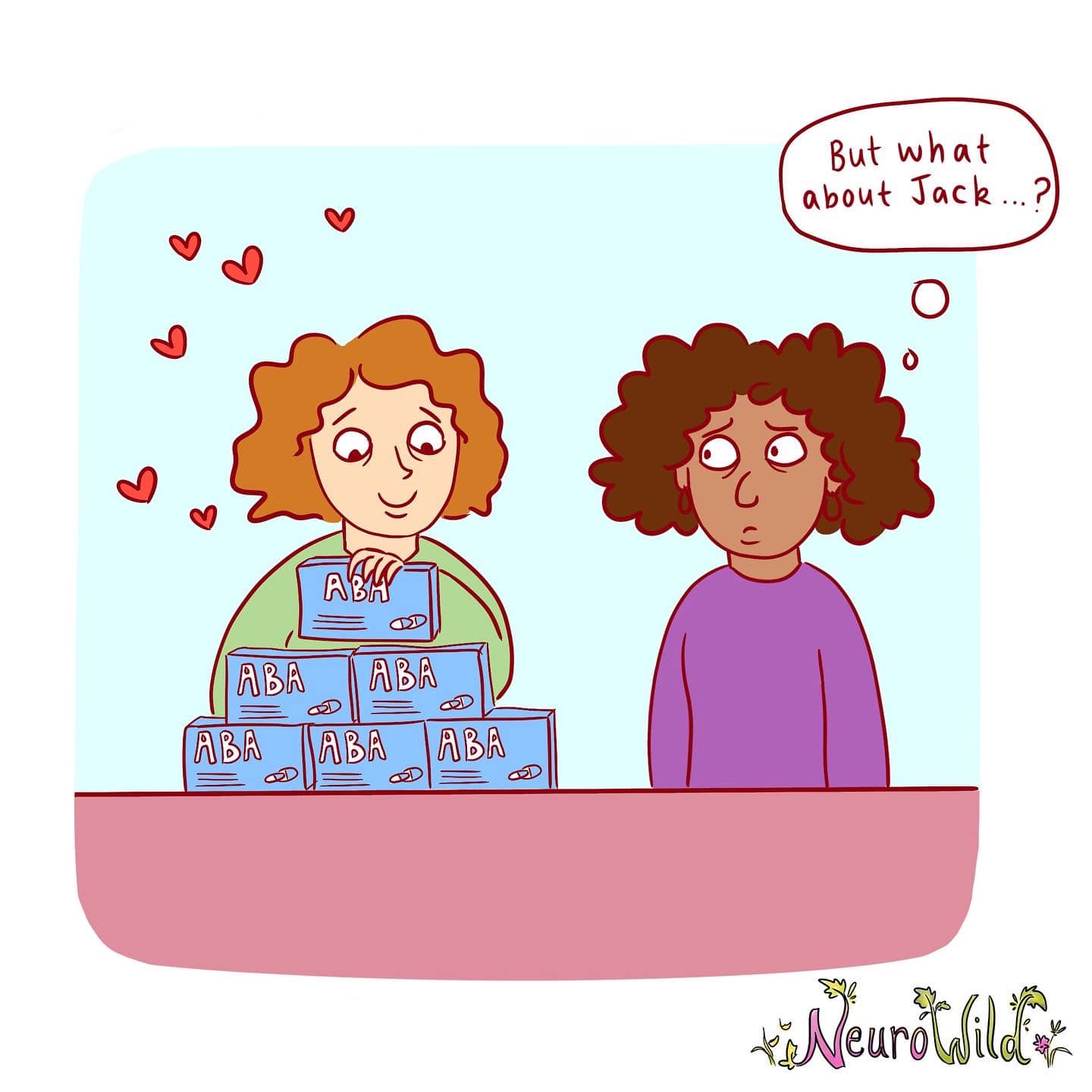
Cartoon comic panel with a light blue rounded square above a pink counter. The orange-haired person in the green sweater clutches the blue box to her chest, looking angry with her mouth open and lines radiating from her head. Speech bubble in capital letters: 'HOW DARE YOU. THIS PRODUCT IS REALLY WORKING FOR US. JACK LOVES IT. WE LOVE IT. Our DOCTOR said it's ESSENTIAL.' The NeuroWild logo is at the bottom right. Cartoon comic panel with a light blue rounded square above a pink counter. The orange-haired person in the green sweater smiles with hearts floating around her head while stacking a pyramid of blue boxes labeled 'ABA', each with a pill drawn on it. The dark-haired person in the purple sweater stands beside her looking worried, with a thought bubble: 'But what about Jack...?' The NeuroWild logo is at the bottom right.

ABA: TLDR

We cannot change how research is done until we understand as a society that Autism and Autistic traits at a fundamental level need to be accepted in our daily lives. It means changing our standards for what is normal so that everyone can be loved, included, and have the opportunity to participate in society.

© 2026 Neurodivergent Upgrade All Rights Reserved

Cookie Preferences