Facts (!)

Read At Your Own Discretion
We are not personally responsible for your usage. We are posting this because we believe some individuals can benefit a great deal if they realize what their normal looks like and why. As an adult you are fully responsible for knowing what you can and cannot handle. This information is here for those who need to know this, based on how their known self-concept.
Statistics
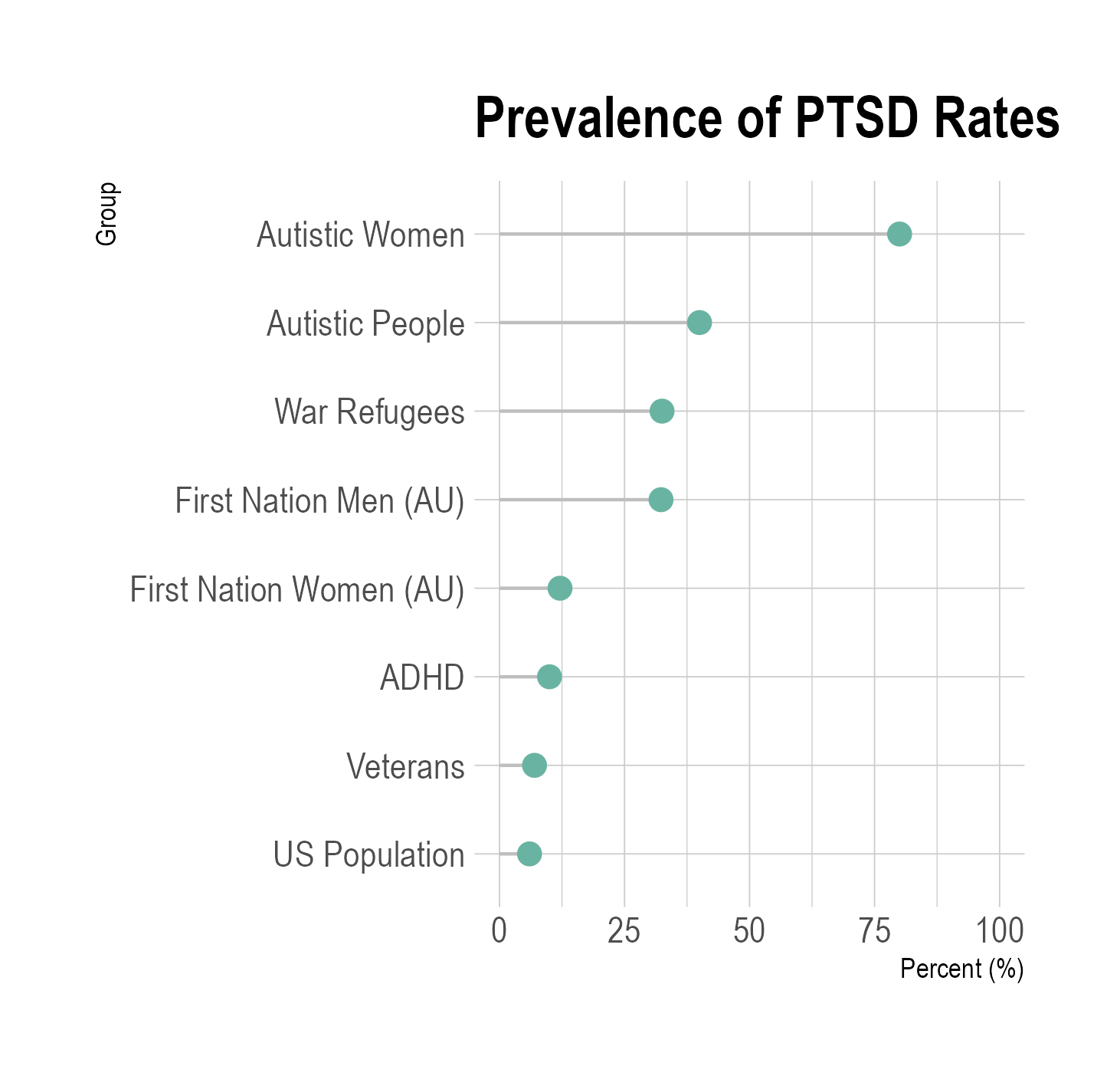
Autism
Sexual Assault and Survivors of Abuse
- A study estimated 90% of women on the spectrum are survivors of sexual violence with 75% of women on the spectrum experiencing multiple counts (Cazalis et al. 2022).
PTSD
- An estimated 40% of women on the spectrum have PTSD (Roberts et al. 2015).
- Other studies conducted more informally through Autism social media groups estimated the rate to be closer to 90%.
Trauma, Depression, and Suicide Rates
- Up to 72% of Autistic adults have severe trauma histories
- Highly skilled people with ASD are the most vulnerable to mental health risks compared to other segments of the autism diagnostic spectrum (Kõlves et al. 2021).
- In Denmark, the suicide rates for men and women are estimated to be three and eight times the population average, respectively (Kõlves et al. 2021). The suicide risk ratio in women with ASD in Denmark is on par with the risk ratios estimated in Aboriginal women in Canada (Kumar and Tjepkema 2019).
https://www.sciencedirect.com/science/article/abs/pii/S0022399919305513 https://www.autism.org.uk/advice-and-guidance/professional-practice/ptsd-autism
ADHD
- Individuals with ADHD are about twice as likely to have PTSD as the average person Gurvits et al. (2000).
Employment
- We have no national employment statistics on ADHD as we do with Autism, which is also a very recent development.
References
Antshel, Kevin M, Prashant Kaul, Joseph Biederman, et al. 2013. “Posttraumatic Stress Disorder in Adult Attention-Deficit/Hyperactivity Disorder: Clinical Features and Familial Transmission.” The Journal of Clinical Psychiatry 74 (3): 14855.
Cazalis, Fabienne, Elisabeth Reyes, Séverine Leduc, and David Gourion. 2022. “Evidence That Nine Autistic Women Out of Ten Have Been Victims of Sexual Violence.” Frontiers in Behavioral Neuroscience, 136.
Fino, E., Denis Mema, and P. M. Russo. 2020. “War Trauma Exposed Refugees and Posttraumatic Stress Disorder: The Moderating Role of Trait Resilience.” Journal Article. Journal of Psychosomatic Research 129. https://doi.org/10.1016/j.jpsychores.2019.109905.
Gurvits, Tamara V, Mark W Gilbertson, Natasha B Lasko, et al. 2000. “Neurologic Soft Signs in Chronic Posttraumatic Stress Disorder.” Archives of General Psychiatry 57 (2): 181–86.
Kõlves, Kairi, Cecilie Fitzgerald, Merete Nordentoft, Stephen James Wood, and Annette Erlangsen. 2021. “Assessment of Suicidal Behaviors Among Individuals with Autism Spectrum Disorder in Denmark.” JAMA Network Open 4 (1): e2033565–65.
Kumar, Mohan B, and Michael Tjepkema. 2019. Suicide Among First Nations People, métis and Inuit (2011-2016): Findings from the 2011 Canadian Census Health and Environment Cohort (CanCHEC). Consumer Policy Research Database.
Roberts, Andrea L., Karestan C. Koenen, Kristen Lyall, Elise B. Robinson, and Marc G. Weisskopf. 2015. “Association of Autistic Traits in Adulthood with Childhood Abuse, Interpersonal Victimization, and Posttraumatic Stress.” Journal Article. Child Abuse & Neglect 45: 135–42. https://doi.org/10.1016/j.chiabu.2015.04.010.